Service Management Orchestration
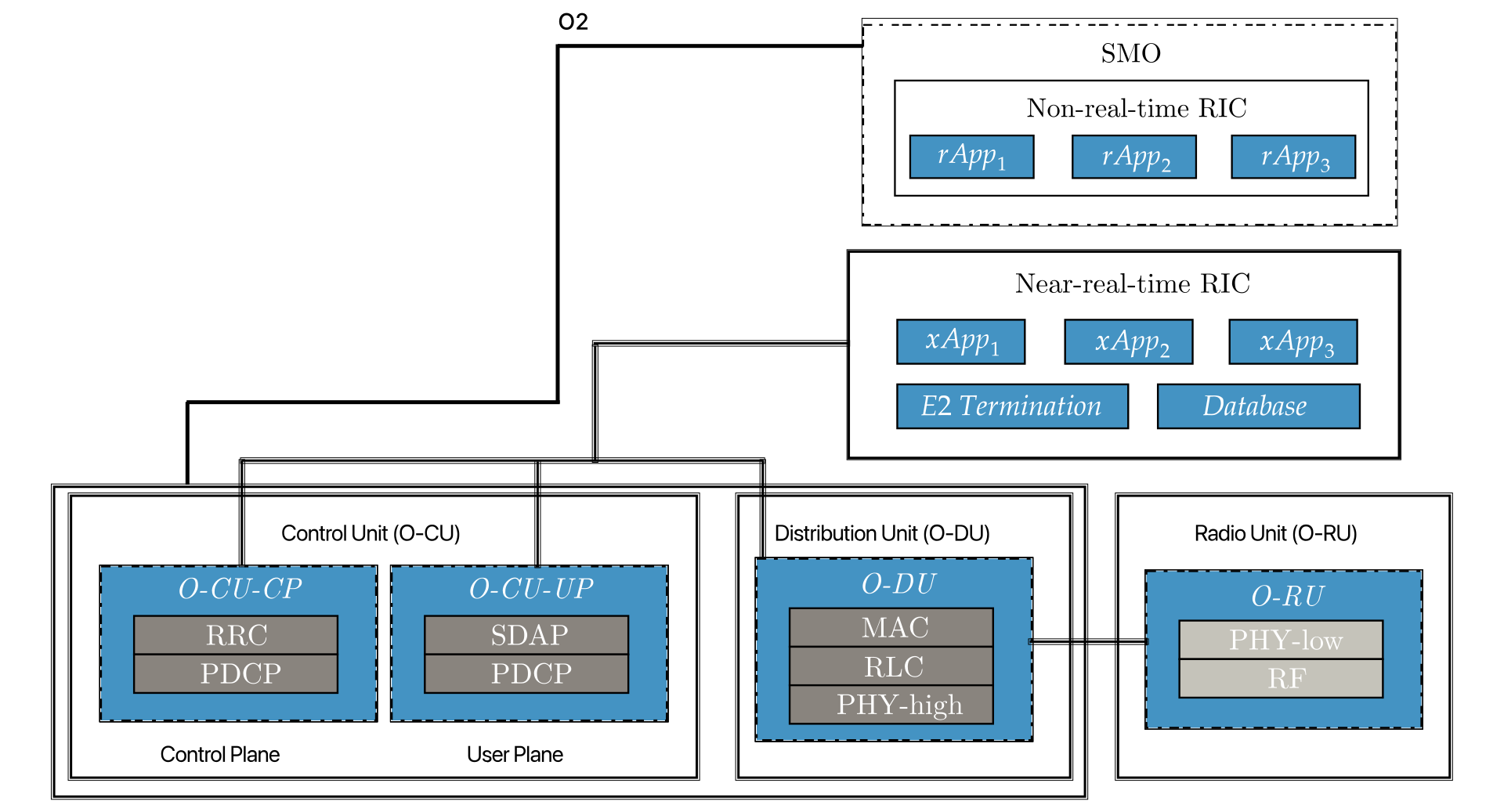
The Service Management and Orchestration (SMO) framework provides centralized management, automation, and orchestration for the entire O-RAN ecosystem. It coordinates the lifecycle of network components, ensures efficient resource allocation, and enables advanced features like network slicing and automation. It interacts closely with the Near-RT RIC; while the SMO operates on a timescale of seconds, the Near-RT RIC functions in the millisecond domain.
Key Responsibilities
- Policy Definition and Enforcement: Collaborates with RICs via the A1 interface to create, update, and enforce intent-based policies that guide xApp behavior in the Near-RT RIC—for example, optimizing carrier or band selection for specific UEs or UE groups to enhance performance and balance network load.
- Statistical Analysis: Provides the Near-RT RIC with enriched analytics from UE measurements—such as RSRP, RSRQ, and CQI for both serving and neighboring cells—enabling more precise optimization and decision-making.
- Lifecycle Management: Automates deployment, configuration, scaling, and updates of O-RAN components (O-RU, O-DU, O-CU, and RICs), supporting both cloud-native and edge deployments.
- Network Slicing: Creates and manages multiple virtual RAN slices to meet specific service requirements—including latency, throughput, and reliability—for different applications or user groups.
- Fault, Performance, and Configuration Management: Monitors the health of network elements, collects KPIs and performance metrics, detects anomalies or faults, and applies corrective actions or triggers automated workflows to maintain network stability.
Connectivity
- O1 Interface:
Connects the SMO to individual RAN components (O-CU, O-DU, O-RU) for element-level monitoring, performance metrics collection (KPIs), configuration management, and fault detection.
- A1 Interface:
Connects the SMO to the Non-RT RIC for policy definition, distribution, and analytics, allowing intent-based control of xApps in the Near-RT RIC. Supports network optimization decisions based on enriched data from SMO and RAN elements.
- O2 Interface:
Provides the SMO with the capability to orchestrate and manage the full lifecycle of virtualized or cloud-native RAN components, including deployment, scaling, updates, and termination. Works at a higher abstraction level than O1, integrating with cloud platforms or orchestration frameworks to automate RAN operations end-to-end.
Deployment Context
- Typically deployed in centralized cloud or data center environments for scalable orchestration across multiple sites.
- Supports multi-vendor interoperability, enabling operators to manage a heterogeneous network seamlessly.
Internal structure
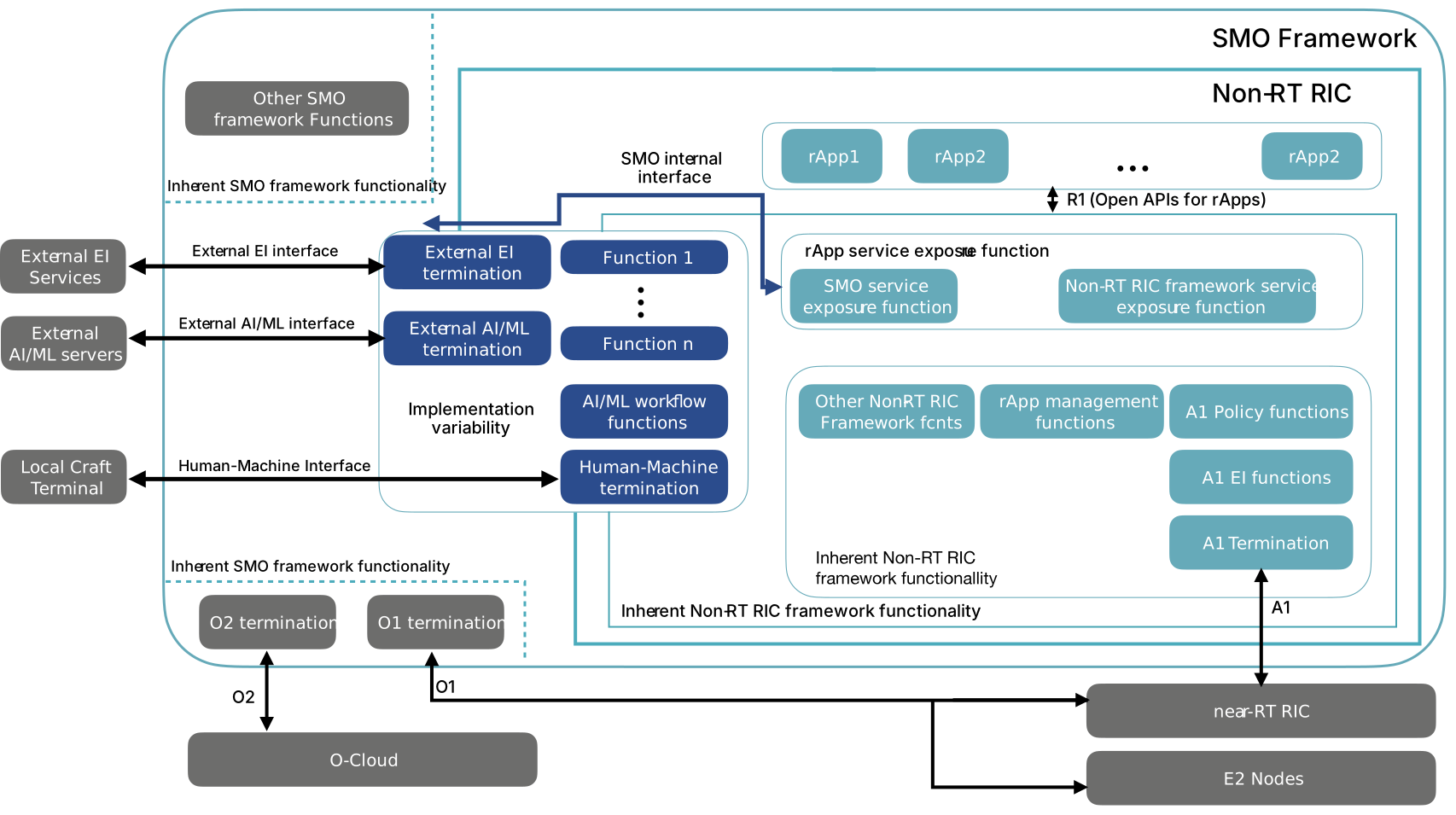
Next, we present the internal structure of the SMO framework, detailing its integration with the Non-RT RIC. The architecture is illustrated in the figure below.
rApps and the R1 Interface
- Similar in concept to xApps deployed on the Near-RT RIC.
- Specific rApps (RAN applications) can be deployed within the Non-RT RIC, which is part of the SMO.
- rApps interact with the Non-RT RIC framework services using the R1 interface (open APIs).
Implementation Variability
- Certain components are implementation-dependent and can be placed either:
- Internal to the Non-RT RIC (tightly integrated), or
- External but accessible via exposure functions (loosely coupled).
- Examples include:
- AI/ML workflow functions
- Model training and retraining
- Inference pipelines
- Model lifecycle management s
- AI/ML workflow functions
Other SMO Framework Functions
- Functions that are external to the Non-RT RIC, but still part of the SMO.
- Marked in the architecture as Other SMO Framework Functions.
- Examples include:
- Network slicing lifecycle management (design, instantiation, scaling, termination)
- End-to-end service orchestration (across RAN, transport, and core)
- Resource inventory and assurance