Protocol Stack
Splitting control-plane processing from user-plane processing allows for more flexible and efficient network deployment. The protocol stack defines the functional entities standardized by the O-RAN Alliance, and these components—O-CU-CP, O-CU-UP, and O-DU—are collectively referred to as E2 nodes. Their roles and definitions are specified by the O-RAN Alliance to ensure interoperability and modularity across vendors.
The PHY is split between the O-RU (lower PHY for RF processing) and O-DU (higher PHY), allowing fast signal processing near the radio and centralizing less time-sensitive functions.
All O-RAN components are connected to the 5G core network (IP core). TheO-CU-CP connects to the AMF (Access and Mobility Management Function) via the N2 interface, allowing the AMF to handle UE registration, authentication, mobility management, and session management. Meanwhile, the O-CU-UP connects to the UPF (User Plane Function) via the N3 interface, handling user data routing, forwarding, and QoS enforcement.
Furthermore, the O-CU-CP, O-CU-UP, and O-DU are connected to the Near-Real-Time RIC using an E2 Interface, as described in the architectural overview.
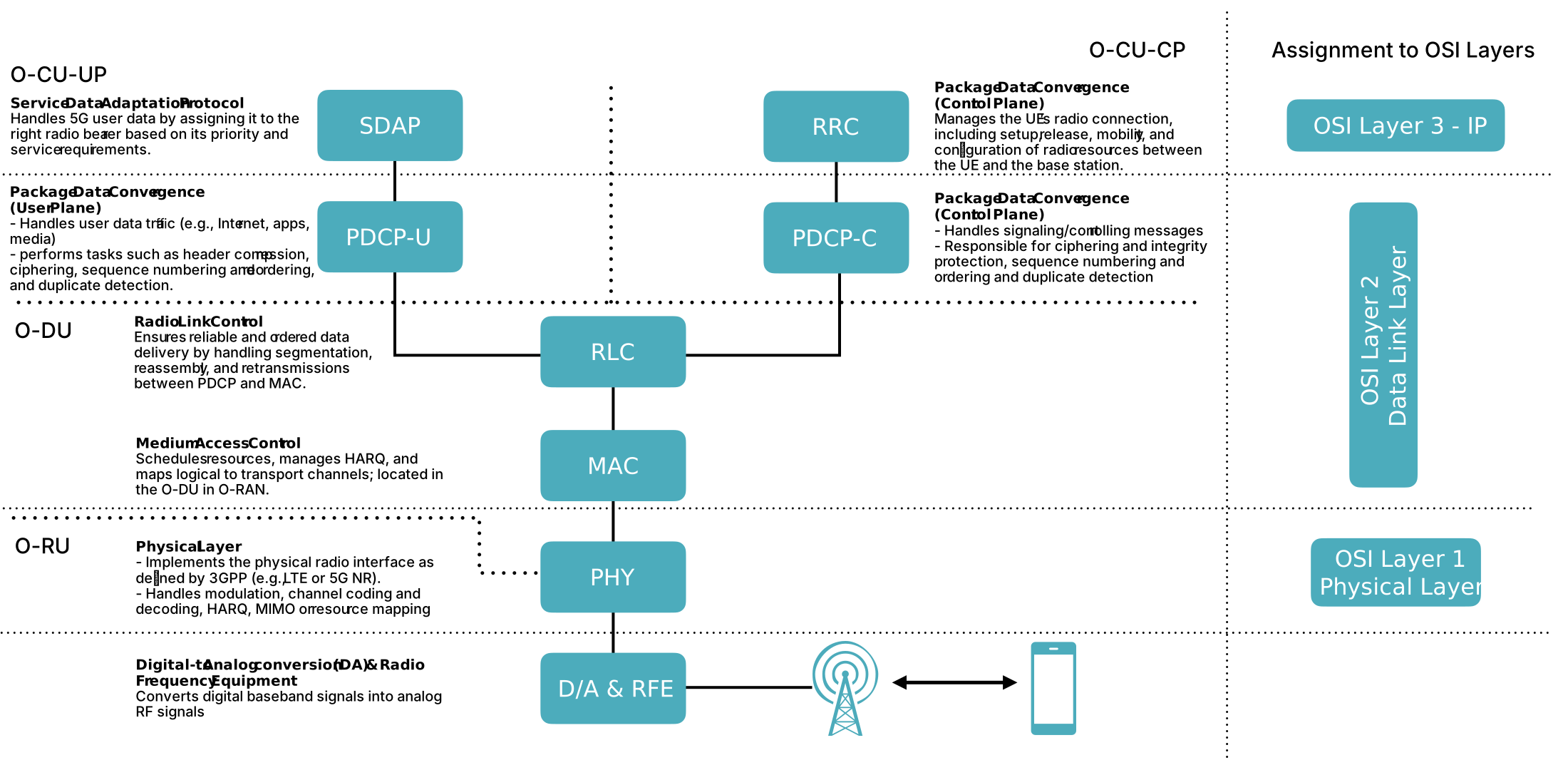
However, the above-mentioned protocols only offer a coarse-grained overview.
To enable a more fine-grained analysis, the protocol stack is further structured as presented in the subsequent figure.
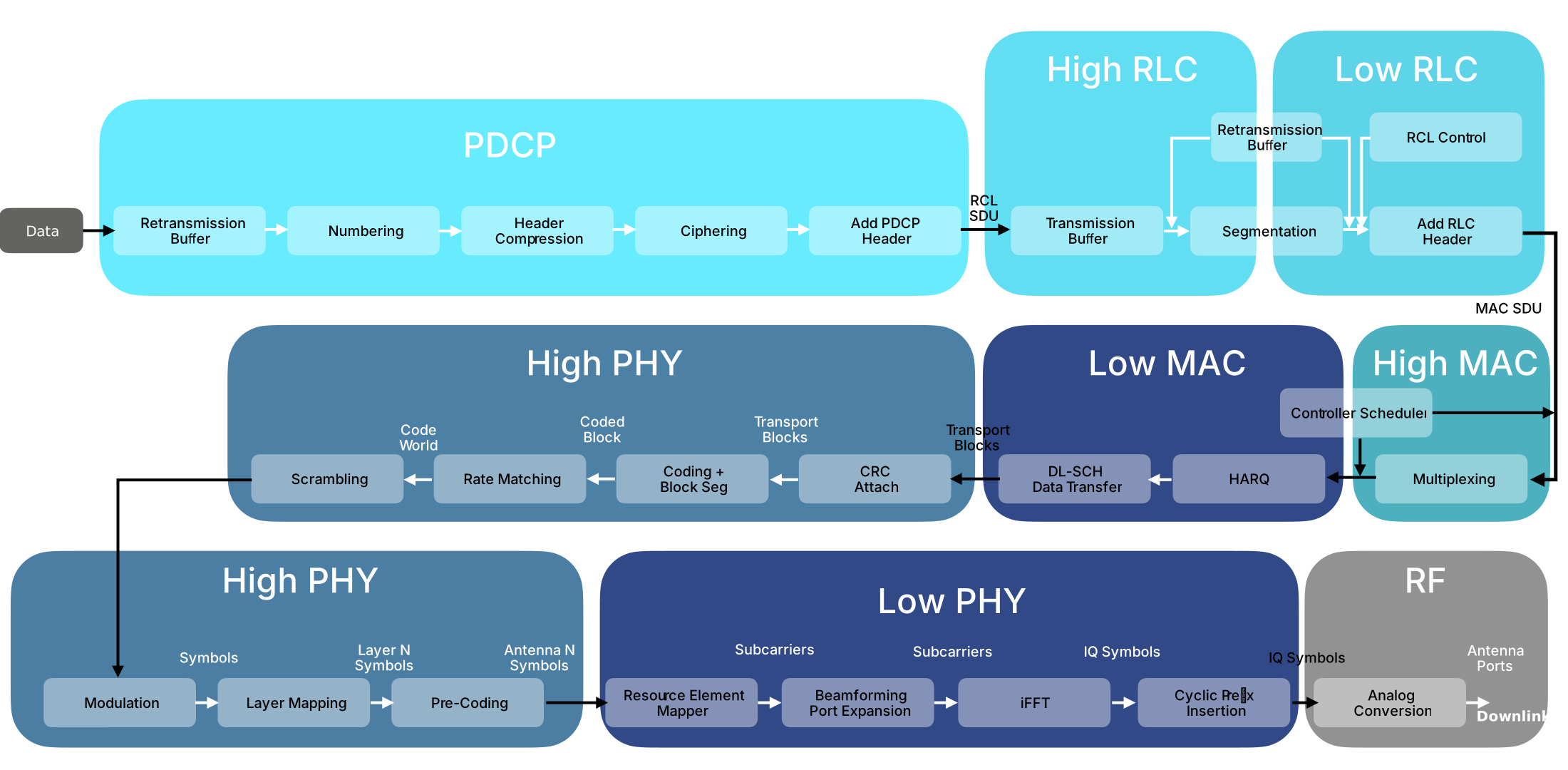
Within the PDCP (Packet Data Convergence Protocol) layer, the processing is further subdivided into five distinct stages:
- Retransmission Buffer: Stores PDCP Protocol Data Units (PDUs) for potential retransmission, ensuring reliability in acknowledged modes.
- Numbering: Assigns sequence numbers to PDUs to support in-order delivery and duplicate detection.
- Header Compression: Reduces protocol overhead (e.g., IP headers) using schemes such as Robust Header Compression (ROHC), thereby improving spectral efficiency.
- Ciphering: Applies encryption to protect the confidentiality of user plane and control plane data.
- Add PDCP Header: Appends the PDCP-specific header to each PDU, carrying information such as sequence numbers and control fields.
The RLC (Radio Link Control) layer is subdivided into a High RLC and a Low RLC part.
Together, these sublayers host the following functional components:
- Transmission Buffer: Stores incoming PDCP SDUs awaiting segmentation and transmission.
- Segmentation: Splits larger PDCP SDUs into smaller RLC PDUs that can be efficiently transmitted over the MAC layer.
- Add RLC Header: Appends RLC-specific headers carrying sequence numbers and control information to each PDU.
- RLC Control: Manages operational modes (Acknowledged, Unacknowledged, Transparent), sequence numbering, and delivery guarantees.
- Retransmission Buffer: Retains transmitted PDUs for potential retransmission in Acknowledged Mode (AM) to ensure reliability.