Near Realtime RIC
The Near-Real-Time RIC (Near-RT RIC) is a key component of the O-RAN architecture that enables intelligent and policy-driven optimization of the RAN. It operates on timescales ranging from 10 milliseconds to 1 second, allowing it to make near-real-time adjustments to network behavior.
Key Responsibilities
- Policy-Based Control: Implements operator-defined policies to dynamically manage radio resources.
- AI/ML-Driven Optimization: Uses data analytics and machine learning to optimize handovers, traffic steering, interference management, and energy efficiency.
- xApp Execution: Runs modular applications (xApps) that extend the RIC’s capabilities for specific optimization tasks.
Connectivity
- Interfaces with O-CU and O-DU over the E2 interface to monitor and control network elements in near real-time.
- Communicates with the Non-RT RIC for policy guidance and long-term optimization.
Deployment Context
- Typically deployed at edge or regional data centers to balance low latency with centralized intelligence.
- Supports multi-vendor environments, enabling interoperability and flexible deployment of new xApps without vendor lock-in.
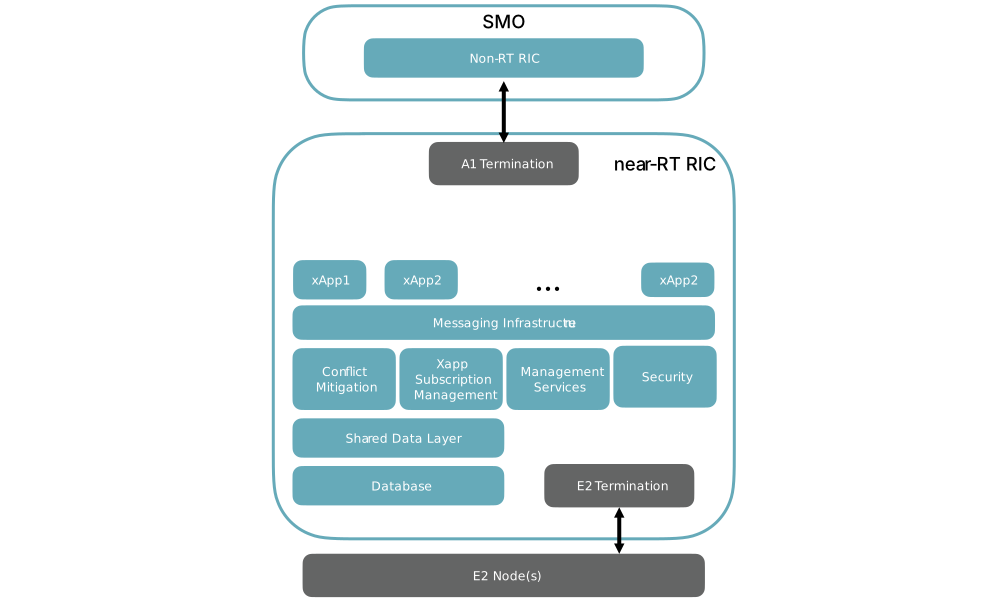
Internally, the Near-RT RIC consists of several key components:
- Shared Data Layer: Manages storage, reading, and writing of RAN and UE information.
- xApp Subscription Management: Handles subscription, modification, and termination of event streams for RAN data and control between the Near-RT RIC and xApps.
- Messaging Infrastructure: Facilitates communication among internal functions of the Near-RT RIC.
- Conflict Mitigation: Resolves potentially conflicting control requests from multiple xApps to ensure network stability.
- Management Services: Includes fault, configuration, and performance management. Also handles xApp lifecycle operations, tracing, metrics collection, and logging.