MIMO and Massive MIMO
Wireless systems can operate in different antenna configurations depending on the number of transmit and receive antennas. The most common modes are:
- SISO (Single-Input Single-Output): One transmit antenna and one receive antenna. This is the simplest configuration.
- SIMO (Single-Input Multiple-Output): One transmit antenna and multiple receive antennas. Provides receive diversity to improve reliability.
- MISO (Multiple-Input Single-Output): Multiple transmit antennas and one receive antenna. Provides transmit diversity to improve signal strength.
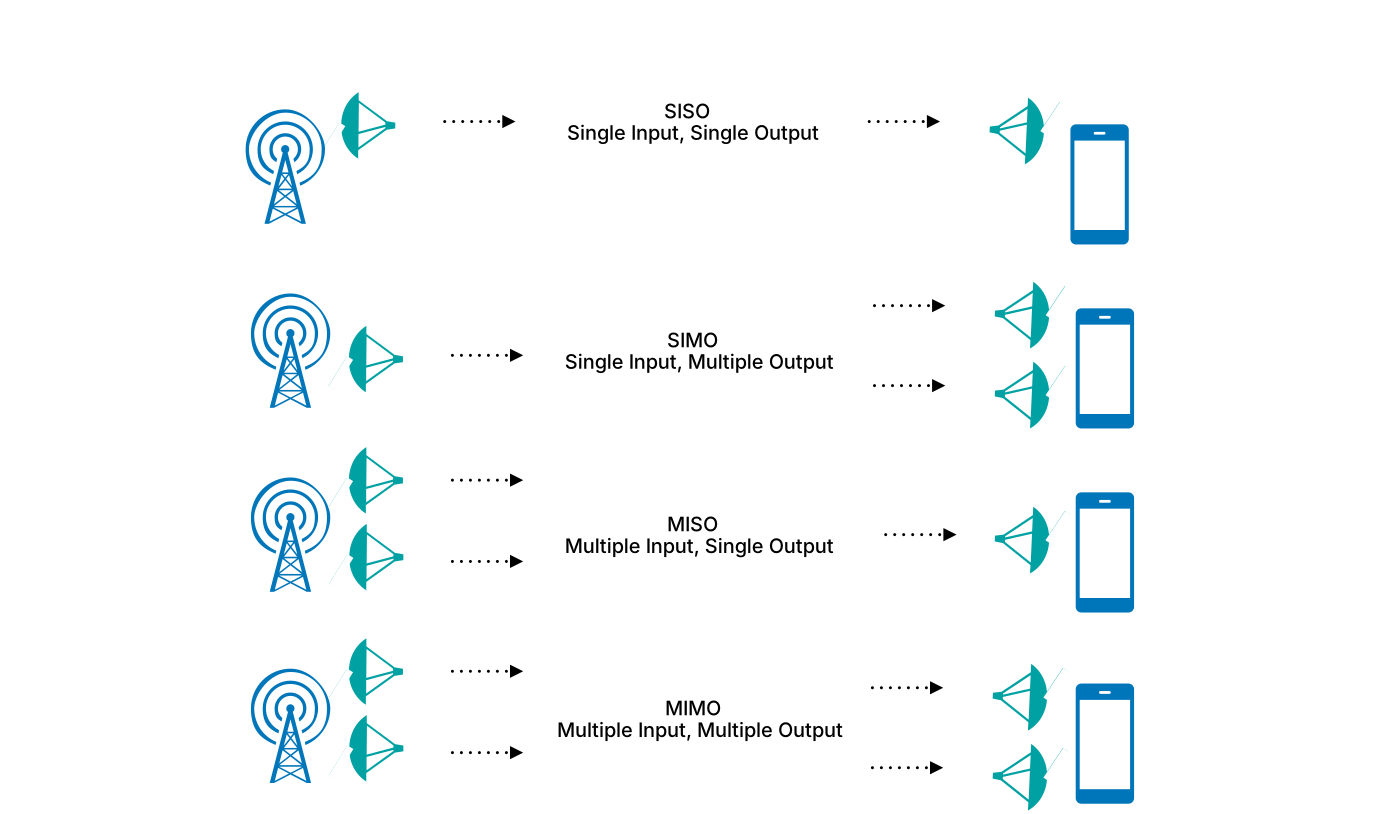
MIMO (Multiple-Input Multiple-Output) is a wireless communication technology that employs multiple antennas at both the transmitter and receiver. This technique offers several advantages:
- Increased Gain: Higher signal-to-noise ratio (SNR) due to combining multiple received signals.
- Improved Reliability: Multiple signals can traverse different paths, increasing the probability of successful transmission.
- Higher Link Capacity: Parallel data streams increase throughput and overall spectral efficiency.
Massive MIMO
Massive MIMO extends the MIMO concept by using very large numbers of antennas (tens or hundreds) at the base station to dramatically increase capacity, energy efficiency, and spatial multiplexing.
In such systems the transmission and reception can be expressed as:
Where:
- : The vector of data symbols transmitted to a user.
- : The precoding (or beamforming) matrix applied at the transmitter to direct energy from the many antennas toward each user, reducing interference.
- : The large channel matrix, describing how each of the many transmit antennas couples to each receive antenna/user (includes fading, path loss, and phase).
- : Additive noise at the receivers.
- : The receiver-side processing function (e.g., detection, equalization, or decoding) applied to the composite signal to recover the transmitted data.
- : The received decoded signal.
Thus, represents the MIMO receiver taking the precoded, channel-affected, noisy signal and processing it to separate and detect the user data streams. Because of the large number of antennas, (H) and are much larger than in standard MIMO, enabling higher spatial multiplexing gains and improved interference suppression.
To increase bandwidth, one approach is to use a higher carrier frequency.
Operating at higher frequencies reduces the physical size of antennas but also limits the power that can be applied to each antenna.
Consequently, more transmitting and receiving antennas are required to maintain link quality.
This results in narrower beams, which help reduce multi-user interference but also decrease multipath diversity.
As a result, the system must accurately track users’ positions and requires more RF chains, making the circuit
board design more complex.
Let the total system bandwidth be constrained as , which represents the maximum available spectral width for transmission.
Analog beamforming is a technique in which signals from multiple antenna elements are combined in the analog
domain (before analog-to-digital conversion) using phase shifters or variable gain amplifiers.
This allows the antenna array to form a directional beam with a single RF chain, reducing hardware complexity and power
consumption at the cost of flexibility compared to digital beamforming.